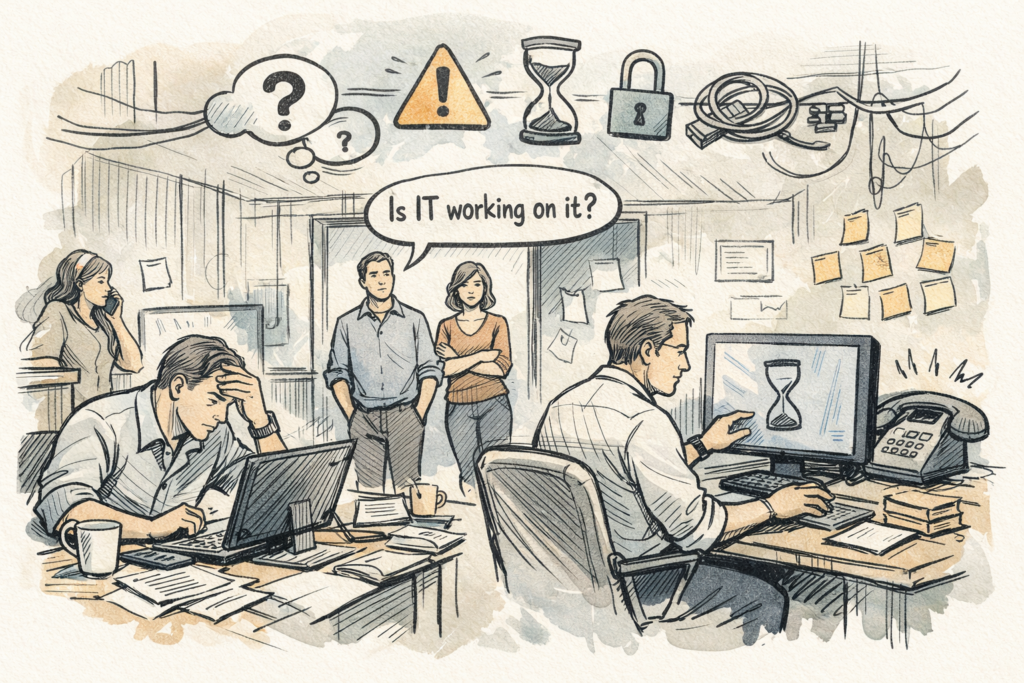
It started small.
Someone couldn’t log into email.
Then the accounting system froze.
Then the phones started acting strange.
Within an hour, half the office was standing in doorways asking the same question:
“Is IT working on it?”
The uncomfortable answer?
There wasn’t a clear “it.”
There were tools.
There were vendors.
There were passwords written down somewhere.
There were good intentions.
But there wasn’t ownership.
There wasn’t structure.
There wasn’t governance.
The Problem Wasn’t Technology
The company had invested in technology.
They had antivirus.
They had backups.
They had a firewall.
They had Microsoft 365.
They had an IT company they could call.
On paper, they were covered.
But here’s what was really happening behind the scenes:
Systems were on different versions.
Some machines were patched. Some weren’t.
Admin access was shared “just in case.”
No one had a documented risk list.
Changes happened when someone thought it was a good idea.
Nothing malicious. Nothing reckless. Just unmanaged. And unmanaged eventually becomes unstable.
The Real Issue: No One Was Running It Like a Business System
Imagine if your accounting department worked like this:
“We think the numbers are close.”
Or your operations team said:
“We upgraded some equipment. Not totally sure what it connects to, but it should be fine.”
You wouldn’t accept that.
Yet many businesses unknowingly accept that level of looseness in IT every day.
Not because they don’t care.
Because no one has framed it differently.
What Governance Actually Looks Like (In Real Life)
Now picture the same company — six months later.
They didn’t buy a pile of new gadgets.
They didn’t double their tech budget.
They did something more powerful.
They put structure around it.
Now:
Every system follows a defined standard.
If something drifts, it gets corrected.
Major changes are reviewed before they happen.
There’s a documented risk register leadership can see.
Security posture is reviewed on a schedule.
Hardware replacements are forecasted — not discovered during failure.
There are regular alignment conversations between business leadership and IT.
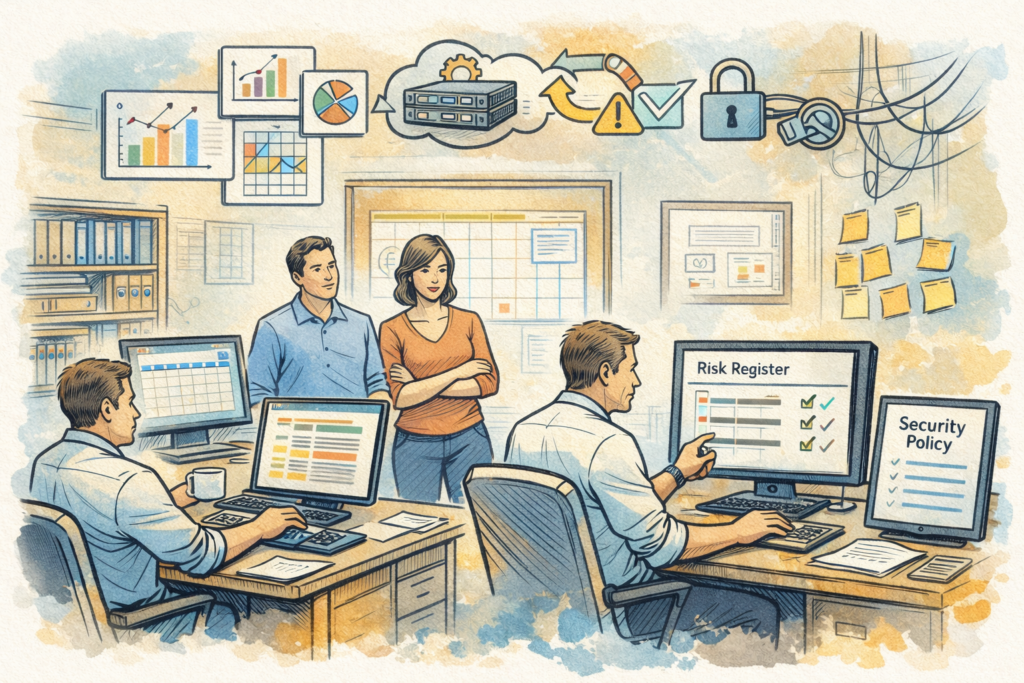
Nothing flashy. Just disciplined. And suddenly… The panic days stop happening.
The Quiet Power of Control
The biggest shift wasn’t technical.
It was emotional.
The CEO stopped bracing for surprise expenses.
The operations manager stopped fearing random outages.
The finance team stopped worrying about audit questions.
There was a plan.
There was visibility.
There was accountability.
Technology stopped feeling like a liability.
It started behaving like infrastructure.
Governance Isn’t About Control for Control’s Sake
It’s not about being rigid.
It’s about running technology the same way you run the rest of your business:
With standards.
With review.
With ownership.
With documented decisions.
When risk is identified, it’s explained in business terms.
When a decision is made not to fix something, it’s formally accepted — not forgotten.
When something changes, it’s intentional.
That’s maturity.
Most Companies Don’t Need More Tools
They need:
Clear authority
Clear standards
Clear accountability
Clear planning
They need someone treating their environment as a governed operating model — not a helpdesk ticket queue.
The Difference You Feel
When IT is governed:
You don’t wonder what shape your systems are in.
You don’t find out about aging hardware during a failure.
You don’t discover security gaps after an incident.
You don’t make budget decisions blind.
You operate with clarity.
And clarity reduces stress more than any software ever could.
The companies that move to governance rarely say:
“Wow, the technology is exciting.”
They say something much more telling:
“It just runs. We’re not worried about it anymore.”
And in business, that kind of quiet confidence?
That’s powerful. That’s Enterprise One.
