A practical look at business maturity, technology risk, and the point where “call us when it breaks” stops being enough.
Most companies do not change IT support models because everything is going wonderfully.
They change because something starts to feel different.
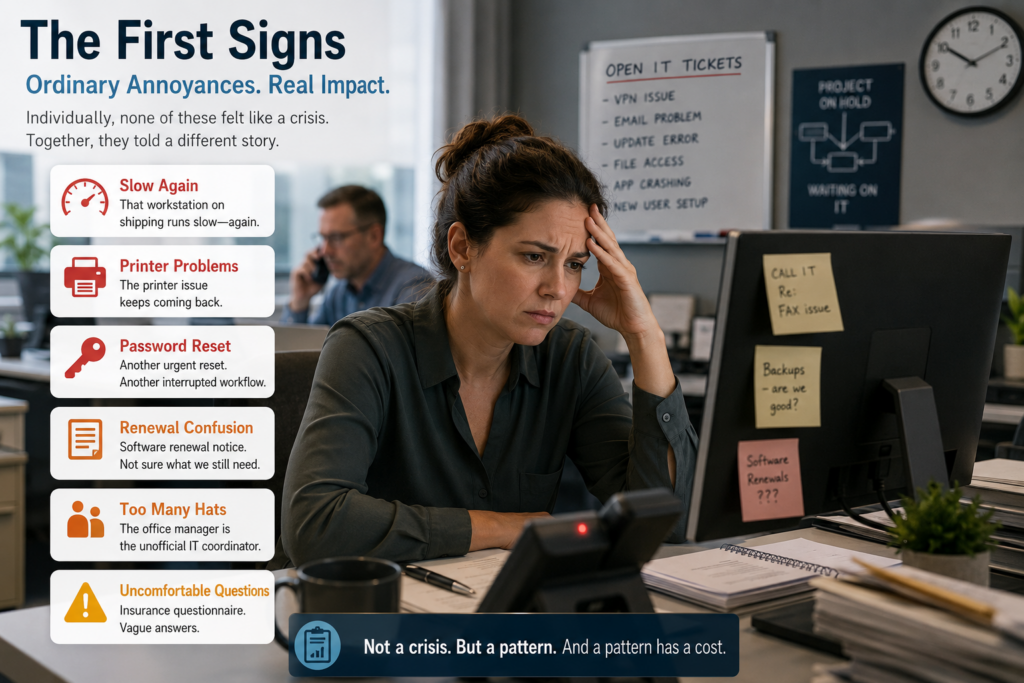
At first, it usually is not dramatic. A workstation slows down again. A printer problem shows up for the third time. A software renewal lands on someone’s desk and no one is completely sure who still uses the licenses. A backup report says everything is fine, but no one can explain what “fine” actually means. Then a cyber insurance renewal shows up asking about MFA, endpoint protection, patching, backups, administrative access, user training, and incident response, and the answers are not as comfortable as everyone hoped.
None of those things, by itself, looks like a crisis. But together they create a pretty important realization: we have someone to call when IT breaks, but we may not have anyone truly accountable for the environment.
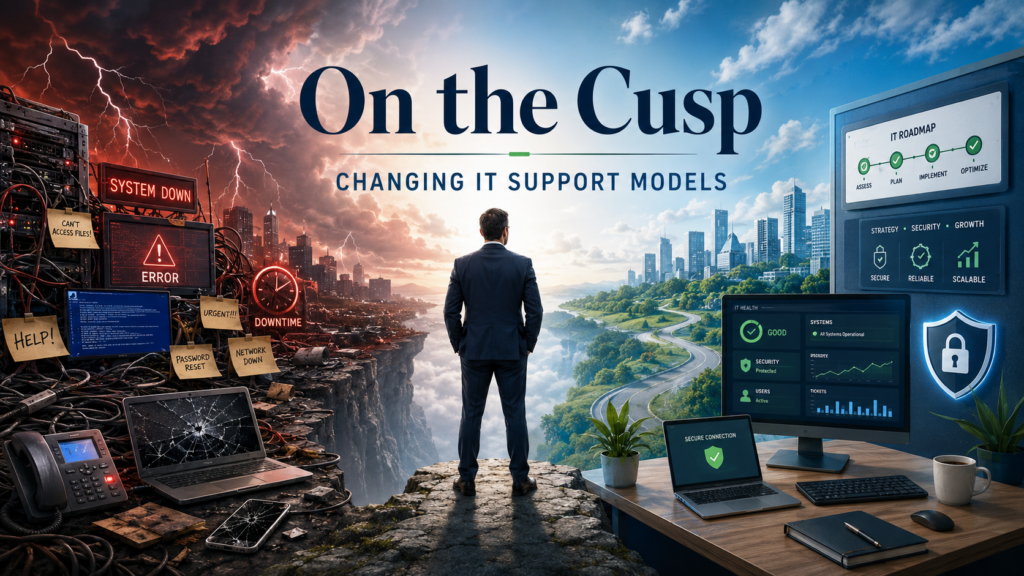
That is the cusp.
A Company That Had Outgrown Its Old Model
Consider North River Components, a fictional company that will feel familiar to a lot of business owners. They are a privately held manufacturer with just under 50 employees, one main office, a small warehouse, a production floor, a few remote users, and growing dependence on Microsoft 365, shared files, line-of-business software, barcode systems, vendor portals, and customer data.
For years, North River handled technology the way many small businesses do. When something broke, someone called the IT provider. A technician came onsite or connected remotely, fixed the immediate problem, and sent an invoice.
That arrangement was familiar. It was simple. It felt economical. And for a long time, it worked well enough.
That last part matters. The old model was not foolish. It served the company during an earlier stage. Break/fix support can make sense when the business is smaller, simpler, and less exposed. The problem was not that the model suddenly became bad. The problem was that the business had changed and the support model had not.
The First Signs Were Ordinary
The early symptoms were easy to ignore because they looked like normal business annoyances.
The same few employees kept getting interrupted by small technical problems. The office manager became the unofficial IT coordinator because someone had to route requests, remember renewals, answer vendor questions, and keep track of who had called about what. The owner was still getting pulled into routine technology decisions that should not have needed ownership attention.
When support was needed, the provider usually responded. That was not really the point.
The deeper issue was that almost everything still depended on someone inside the company noticing a problem, deciding it mattered, and initiating the request. IT was still being treated as a repair function.
North River had grown past that.
The Trigger Was Confidence, Not Catastrophe
The turning point was not a server crash. It was not ransomware. It was not one big ugly event that made the decision obvious.
It was a cyber insurance questionnaire.
That questionnaire forced leadership to look at the environment differently. Did every user have multifactor authentication? Were systems patched consistently? Were backups monitored, or actually tested? Who had administrative access? Which systems were unsupported or nearing end of life? What risks had been accepted simply because replacing something felt inconvenient?
North River had tools. They had support. They had antivirus. They had backups. They had someone to call.
What they did not have was confidence.
That is a dangerous gap. A business can own a lot of technology and still not have a clear operating model for managing it.
The First Misdiagnosis
At first, leadership assumed the answer was to find a different IT company.
That reaction is understandable. When technology feels messy, the provider becomes the visible target. Response times, invoices, recurring issues, unclear advice, and project surprises all get bundled together under vendor dissatisfaction.
Sometimes the provider really is the problem.
But a lot of times, the deeper issue is that the business is evaluating vendors before it has decided what kind of relationship it actually needs.
A break/fix relationship can produce good technical work, but it is built around incidents. A managed support relationship creates more structure, more standardization, more monitoring, and more day-to-day consistency. A governance relationship goes further by adding standards, planning, documentation, lifecycle management, risk tracking, and leadership-level accountability.
Those are not just different pricing models. They are different assumptions about responsibility.
What the Review Really Found
When North River finally looked under the hood, they did not find one giant failure. They found accumulation.
There were aging computers still in service because replacement had been deferred. There were inconsistent software versions. There were old user accounts that needed review. There were backup reports, but not enough evidence that restores had been tested. There were devices added over time without much documentation. There were security tools installed, but not enough conversation about whether those tools were part of a managed security posture.
Most of it was ordinary.
That was exactly the point.
Risk in small and mid-sized businesses rarely shows up as one obvious defect. More often, it builds through small decisions, informal exceptions, delayed replacements, undocumented changes, and assumptions no one has revisited.
North River did not have an IT disaster. They had unmanaged drift.
The Real Decision
Once leadership saw the situation clearly, the question changed.
They were not choosing between cheap IT and expensive IT. That is too shallow, and it usually leads to the wrong conversation.
They were choosing where the risk would sit.
Under the old model, most of the risk sat quietly with the business. The provider repaired what was visible. The company owned everything that was not being reviewed, standardized, documented, tested, or planned.
Under a more structured support model, some of that risk could be managed inside defined boundaries. Day-to-day support would become more organized. Monitoring, patching, security tooling, documentation, and routine maintenance would create a more dependable operating baseline.
Under a governance model, the relationship would go even further. Technology would be managed as a business system. Risks would be identified and reviewed. Standards would matter. Projects would be planned instead of discovered during emergencies. Leadership would have a clearer view of what needed attention, why it mattered, and what decisions belonged on the roadmap.
The right answer depended on what the business expected from IT.
The Hard Part Was Not Technical
The hard part was not installing tools or replacing equipment.
The hard part was changing habits.
The owner was used to making final decisions on nearly every technology matter, even the small ones. The office manager was used to routing issues informally. Employees were used to asking whoever seemed most likely to help. Old systems stayed in place because replacing them would be inconvenient. Some risks were tolerated because nobody had forced a plain conversation about them.
A more accountable IT model challenges those habits.
If a business wants better outcomes, it cannot keep treating IT as a loose collection of devices, tickets, exceptions, and last-minute approvals. A provider cannot be accountable for an environment without enough authority to manage standards. Leadership cannot expect predictability while delaying every lifecycle decision. The business cannot expect lower risk while preserving every informal workaround.
A business cannot expect managed outcomes while preserving unmanaged habits.
That is uncomfortable, but it is also useful. It moves the conversation from blame to ownership.
What Changed on the Other Side
The change was not dramatic on day one. There was no heroic fix. No switch was flipped that made IT perfect.
Instead, the business started operating with more discipline.
Support requests went through a defined process. Recurring issues were tracked instead of treated as isolated annoyances. Systems were documented. Access was reviewed. Backup expectations were clarified. Security tools were tied to responsibility, not merely installed and forgotten. Aging equipment was placed on a lifecycle plan. Projects were scoped before they became urgent.
Leadership also began seeing technology differently.
IT was no longer just a cost that appeared when something broke. It became part of operational planning. That changed the tone of the conversation.
Instead of asking why an emergency cost so much after the fact, leadership could ask what needed to be planned over the next six to twelve months. Instead of assuming backups were fine, they could ask for evidence. Instead of treating security as a checklist, they could discuss risk. Instead of letting technology decisions pile up in the office manager’s lap, the company had a defined structure.
The owner was still involved where leadership judgment was needed. He was no longer the default IT manager.
Why This Matters More Now
This issue is becoming more important, not less.
The traditional IT support model is changing. A lot of basic support will continue to become more automated. Some of that is good. Routine work should be standardized, monitored, automated, and handled efficiently whenever possible.
But automation does not replace business understanding. It does not know why a production floor cannot be down on a Tuesday morning. It does not know which customer portal matters most, which vendor relationship is fragile, or which risk the owner is willing to accept temporarily because cash flow is being used somewhere else this quarter.
That is where the human relationship still matters.
Good IT is not only about tools. It is about knowing the business, understanding the pressure points, helping make tradeoffs, documenting risk, and keeping the conversation moving. Sometimes that means fixing the problem. Sometimes it means creating a temporary workaround so the business can keep operating. Sometimes it means telling a client, plainly and respectfully, that the current path carries risk and needs to be on the roadmap.
That is not rigid. It is responsible.
The Lesson
North River did not need to condemn its old support model. Reactive support had served the company during an earlier stage of growth. It was appropriate when the business was smaller, simpler, and less exposed.
The mistake would have been expecting that same model to keep working after the business had become more dependent on technology.
That is where many companies get stuck. They look for a better technician when the real need is a better operating model.
A technician can fix a broken workstation. A support plan can create more consistency. A governance model can help leadership manage technology risk as part of the business.
Those are different jobs. Confusing them creates frustration for all involved.
Questions Worth Asking
A business may be approaching this same cusp if leadership is asking questions like these:
Why do the same IT issues keep coming back? Why does support still depend on one internal person coordinating everything? Why are technology costs difficult to predict? Why are security and backup answers less clear than they should be? Why do projects feel reactive instead of planned? Why does the owner still get pulled into routine IT decisions? Why does the business have tools, but not confidence?
Those are not only IT questions. They are management questions.
The Cusp
Every growing business eventually reaches a point where the old support model deserves an honest review.
Not because it was foolish. Not because the provider was necessarily bad. Not because every company needs the most advanced service model available.
But because the business changed.
More users. More systems. More cloud dependence. More security exposure. More customer expectations. More financial impact when technology fails. More questions from insurers, auditors, vendors, and leadership.
At that point, the question is no longer, “Who do we call when something breaks?”
The better question is: “What level of accountability does the business now require?”
One model fixes what breaks. One helps keep operations stable. One manages technology as a business risk and business asset.
The difference matters.
And when a leadership team starts to feel that quiet tension — recurring issues, unclear ownership, rising risk, and the sense that technology is becoming harder to control — it should not ignore it.
That may be the business reaching the edge of its old model.
That is the cusp.
A Practical Next Step
If this sounds familiar, the useful next step is not necessarily to start shopping for another IT provider.
The better first step is to clarify what kind of IT relationship your business now requires: repair, operational support, or accountable governance.
That conversation can save a lot of time and frustration. It can also reveal whether the real issue is the vendor, the model, or the habits around how technology decisions are being made.
If your business is starting to feel that tension, it may be worth taking a careful look at whether your current IT support model still fits the business you have become.
